Mock Server
Stand up realistic mock APIs in seconds, without leaving Atrahasis. Built-in server, multiple services running side by side, live edits with no restart, and rule-based matching that decides which response fires. Author mocks the same way you author real endpoints.
Built-In, No External Server
The mock runtime ships with the app. No Docker, no separate Node process, no configuration files. Pick a port, hit Start, you have a live API.
Edit Live, No Restart
Add, change, or remove an endpoint while the server is running. Changes are live on the next request, and your in-flight calls never break.
One Endpoint, Many Scenarios
Stack multiple request and response variants on the same endpoint. Rules decide which fires: success, validation error, unauthorized, timeout, all in one place.
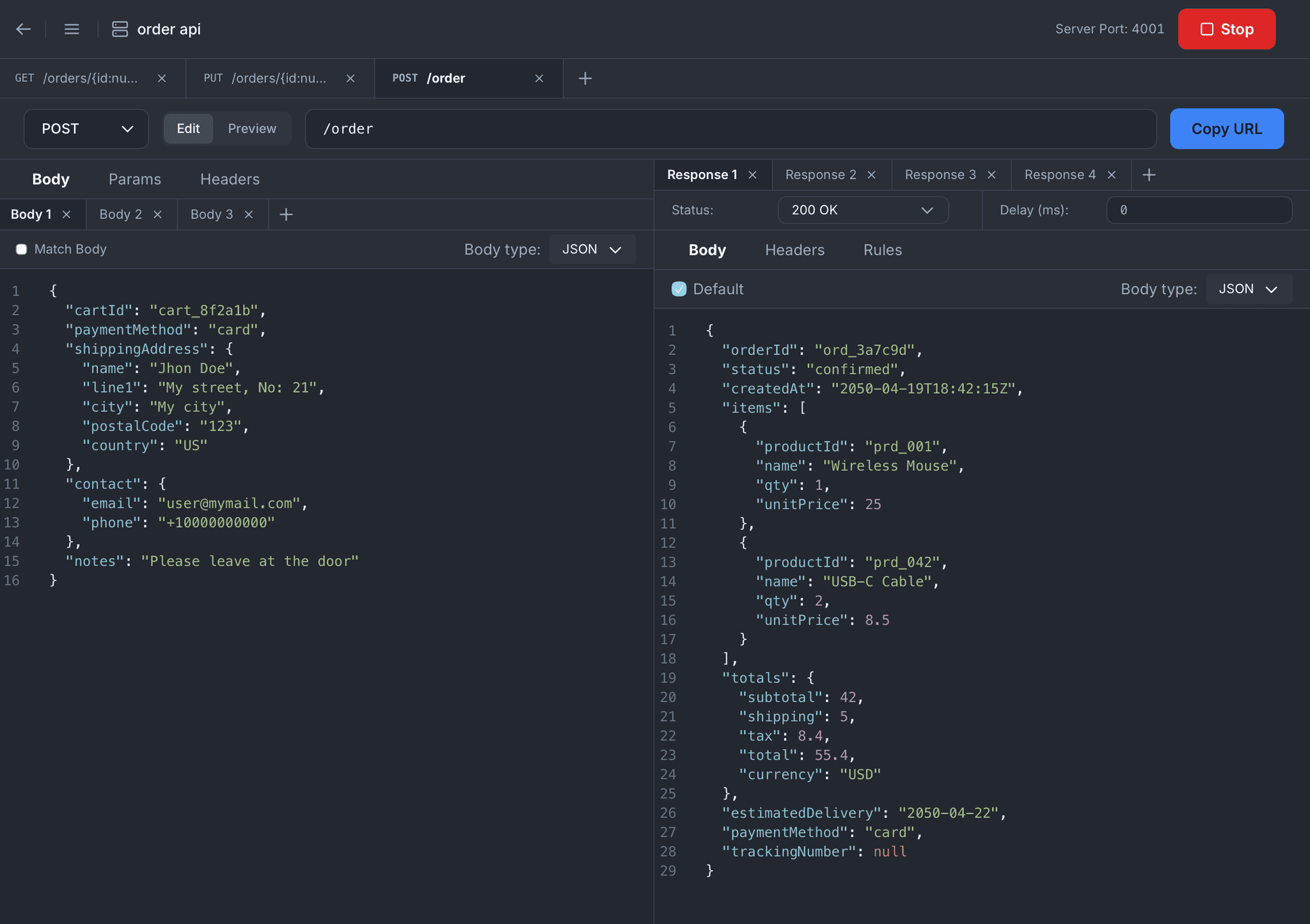
Endpoint Editor
Every endpoint lives in the same familiar request panel. Pick a method and path, define the response body, set a status code, add headers, tune a delay. The left side is what you expect to receive, the right side is what you send back. No round-trip to a config file.
Multiple Variants Side by Side
Stack as many request variants and response variants on the same endpoint as your API needs. Success, validation error, unauthorized, rate-limit, gateway timeout, all authored in one place with tabs you can switch between without losing context.
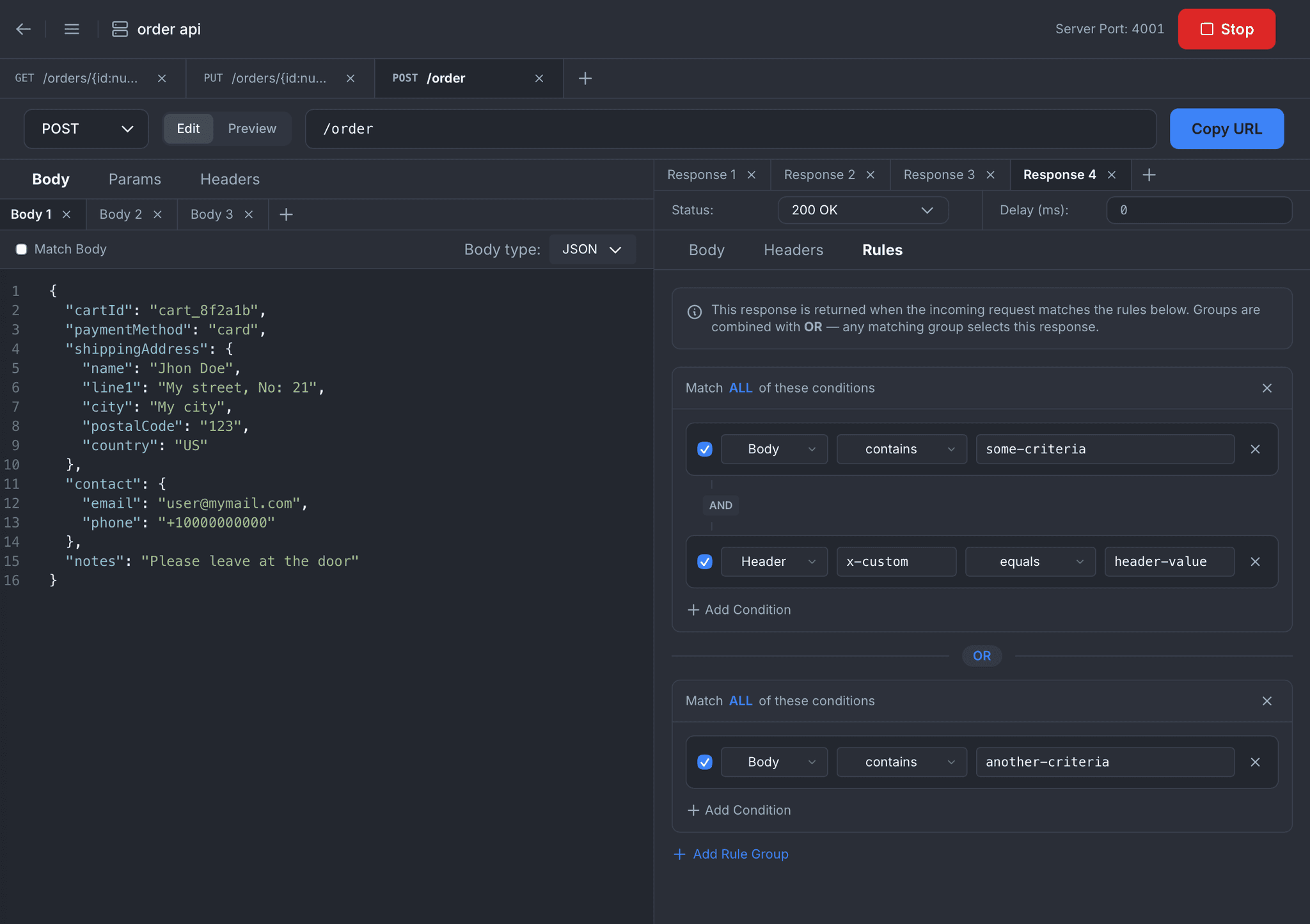
Conditional Rules
Decide which variant fires from the request itself. Match on headers, body content, or a JSON path expression. Each group combines its conditions with AND or OR, and the groups themselves are OR'd, so any matching group wins. Everything falls back to your default response if nothing matches.
Built Into the App
Every mock runs inside Atrahasis itself. No companion process to start, no virtual machine, no container. Pick the port you want, confirm it is free, and the server is listening.
Run as many independent services as your team needs. Each one has its own endpoints, its own port, and its own start/stop button.
What Built-In Really Means
- Multiple servers running side by side on different ports
- Start and stop each server independently, with no cross-impact
- Port availability is validated before a server binds
- Nothing to install: no Docker, no Node, no external runtime
- Reserved ports guarded against accidental collisions
Change Anything, Any Time
- Add an endpoint and it is live on the next request
- Edit a response body, status, headers, or delay and the change takes effect immediately
- Delete an endpoint and it is gone from the routing the instant you confirm
- In-flight requests are never interrupted by an edit
- No restart dialog, no reload step
Live Edits Without a Restart
Classic mock servers ask you to restart every time you change an endpoint. Atrahasis treats authoring as the normal state of the server, so every edit you make is live the moment you hit Save.
That difference matters when you are iterating with a consumer team sitting next to you.
Rule-Based Matching
Every response variant can be gated by rules. Match on what the request is actually carrying, combine conditions with AND and OR, fall back to your default when nothing fits.
Match Targets
- HeaderMatch against any incoming request header by name (case-insensitive).
- BodyMatch against the raw request body text.
- JSON PathExtract a value using $.field or $.nested.field[0] and compare it.
Operators
- equals / not equals
- contains / not contains
- exists / not exists
- is empty / is not empty
- matches regex
Group operators: AND between rules within a group, OR between groups.
OpenAPI-Aligned Authoring
If you have written an OpenAPI spec before, the mock authoring model will feel like home. Typed path parameters, content-type variants, multiple responses per endpoint: the same shape, without learning a new DSL.
Build mocks that match the contract your team already agreed on.
What You Get
- Typed path parameters: {id:number}, {id:uuid}, {email:email}, {slug:slug}, {val:boolean}, {val:alphanumeric}, {val:double}, {val:string}
- Custom regex parameters for codes and identifiers: {code:[A-Z]{2}\d{4}}
- Wildcard routes with /** for catch-all prefixes
- Express-style parameters also supported: :id alongside {id}
- Request and response variants keyed by Content-Type
- Multiple responses per endpoint, one per scenario, just like OpenAPI examples
More Than a Stub
Details that make the mock feel like a real API during development, not a thin placeholder that breaks the second you push on it.
Latency Simulation
Per-endpoint delay in milliseconds, so you can simulate slow dependencies without slowing down your real stack.
Dynamic Responses
Drop {{random.*}} placeholders into response body and headers for per-request unique IDs, names, timestamps, and more.
Query Param Matching
Route based on the presence and shape of query parameters, whose values can use the same type syntax as path parameters.
Smart Error Responses
Automatic 401 on auth header mismatch, 415 on Content-Type mismatch, and 400 on other header or body mismatches, with no manual wiring.
Copy URL
One click copies the full mock URL for any endpoint, ready to paste into the request tab, a flow step, or a load test.
Preview
See exactly what your mock will return, including which variant is selected for a given request, before you hit Run.
Ready to stand up a mock in seconds?
Download Atrahasis and run real mock APIs from the same editor you build requests with.